

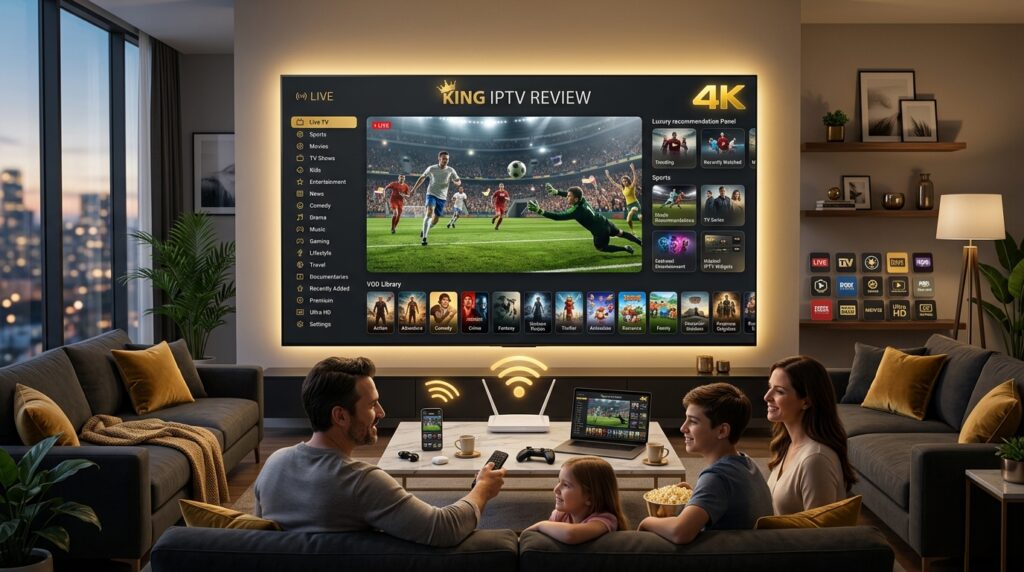
Positioning and Audience
King IPTV routes television through your broadband rather than a dish or coaxial line. The Wikipedia entry on Internet Protocol Television covers the underlying architecture for anyone curious about the mechanics.
Where this brand differs from the budget tier is its self-positioning. It markets toward viewers willing to pay more for smoother onboarding and better support rather than the absolute lowest figure.
Its natural fit includes:
- Newcomers who want guided setup rather than technical guesswork
- Households running three or four screens concurrently
- Heavy catalogue watchers drawn by the large VOD library
- Viewers with strong connections capable of feeding multiple streams
That framing matters, because judging King IPTV against a nine-dollar competitor misses what it is attempting.
Channel Lineup and Catalogue
The advertised inventory covers familiar ground:
- Channels spanning American, British, Canadian and international regions
- Sports across major leagues plus event packages
- News, children’s programming, lifestyle and documentary categories
- A substantial film and series library
- HD, FHD and selective 4K delivery
Published totals range between 15,000 and 19,500 channels depending on which page you land on, with VOD claims from 80,000 to 120,000 titles. Variation of that magnitude signals estimation rather than measurement.
There is a related point worth internalising. In any lineup approaching twenty thousand channels, a portion sits offline at any given moment. That is normal across the entire category, but it means the headline figure describes inventory rather than functioning inventory.
Our full IPTV channels list is itemised by region precisely so the number means something.
Delivery Quality Under Different Conditions
Performance reports on King IPTV are broadly favourable with a consistent caveat attached.
What reviewers generally describe:
- HD and FHD channels rendering cleanly on stable connections
- 4K availability tied to specific streams rather than blanket coverage
- Ordinary evenings running without notable complaint
- Championship-scale events producing intermittent wobbles
- A subset of niche channels dark at any given time
The pattern is worth naming plainly. Routine viewing rarely generates complaints. The friction concentrates precisely around the fixtures people plan their evening around, which is also where infrastructure investment separates providers most visibly.
Where the Premium Actually Shows
Three areas justify the higher asking price, and they are worth acknowledging fairly.
Onboarding simplicity. Setup on a Fire TV stick draws repeated praise from reviewers who describe it as genuinely beginner-appropriate rather than merely tolerable.
Support responsiveness. Multiple independent assessments note that queries receive attention rather than disappearing into a queue. In a category where support frequently means silence, that carries weight.
Household concurrency. Plans supporting two, three and four simultaneous devices are structured properly, meaning concurrent streams rather than merely registered devices. Several competitors blur that distinction.
Those three together represent real value for the right buyer. Whether they justify a doubled monthly figure against budget alternatives depends entirely on how much friction you are willing to absorb elsewhere.
The Refund Window Closes Fast
This deserves explicit attention because it shapes your risk.
Reported terms indicate that refunds generally become unavailable once credentials are issued and activated. The logic is defensible from the provider’s perspective, since the product has technically been delivered. The practical effect on you is less comfortable.
What that means in sequence:
- You pay
- Credentials arrive within minutes
- Activation occurs
- Refund eligibility ends
The gap between payment and losing refund rights can be under an hour. Anyone considering a twelve-month commitment should recognise that trial performance becomes the entirety of your evidence base, since the safety net vanishes almost immediately after purchase.
Confirm current terms directly with whoever processes your payment, in writing, before proceeding.
Verifying Which Site You Are Using
Several domains market under King-adjacent branding, which creates practical confusion.
Before purchasing anywhere:
- Note the exact domain in your browser address bar
- Confirm the pricing on that specific page rather than a review
- Ask which entity appears on your payment statement
- Retain the confirmation email showing the transacting party
This is not unique to King IPTV. It is endemic across the category. But awareness costs nothing and occasionally saves considerable frustration.
Legality and Licensing
Straight answer: the technology is lawful, and paying for a subscription is lawful. What determines legality is whether the operator licenses what it distributes.
King IPTV, in common with nearly all comparable services, publishes limited verifiable licensing information, and independent reviewers describe it as operating in an ambiguous zone. When extensive premium content streams at consumer subscription rates, the economics warrant scrutiny, since genuine licensing carries substantially higher costs. Unlicensed streaming is unlawful in the United States and most jurisdictions, and the U.S. Copyright Office documents how content rights function.
Pricing Structure
Reported figures place King IPTV above the category midpoint.
- Single connection monthly around $17 to $22
- Six and twelve month terms reducing the effective monthly rate
- Multi-connection tiers at two, three and four concurrent streams
- Promotional annual pricing appearing periodically, so figures move
At the top of that monthly range, King IPTV asks roughly double what several competitors charge. The onboarding and support quality partially explain that gap. The peak-event reports complicate the justification.
Our pricing page publishes every figure without requiring contact first.
Connection Requirements
Delivery tracks your bandwidth regardless of provider. Per the FCC Broadband Speed Guide:
- Standard definition: approximately 5 Mbps
- High definition and FHD: approximately 10 Mbps
- Ultra HD: 25 Mbps for each concurrent stream
With four-connection plans available, a household using them fully needs meaningful headroom. Something above 100 Mbps prevents the connection itself becoming the constraint.
Establish your actual throughput at Speedtest.net before attributing playback issues to any service.
Four adjustments resolving most complaints:
- Wire the primary television directly
- Reduce router-to-device distance
- Schedule heavy downloads outside viewing hours
- Restart the router weekly
Assessment: Strengths Against Weaknesses
What works:
- Onboarding genuinely suited to non-technical users
- Support that engages rather than deflects
- Properly structured multi-connection plans
- Extensive catalogue for on-demand watchers
- Broad hardware compatibility
- Trial access before commitment
What does not:
- Monthly pricing well above category average
- Peak-event wobbles reported consistently
- Refund eligibility ending at activation
- Channel figures varying across its own pages
- Portions of the lineup offline at any moment
- Licensing detail absent from public materials
Structural Comparison
The distinction between tiers rarely reduces to channel totals.
| Dimension | Ambiguous-Tier Service | Transparent Provider |
|---|---|---|
| Peak-event behaviour | Wobbles reported | Load-balanced infrastructure |
| Refund eligibility | Ends at activation | Published window |
| Pricing consistency | Varies by page | Single published figure |
| Licensing disclosure | Absent | Stated clearly |
| Support engagement | Generally responsive | Minutes, consistently |
Recognising which column you are entering matters more than the marketing surrounding either.
Hardware Compatibility
King IPTV states support for:
- Amazon Fire TV Stick and Cube
- Android handsets, tablets and boxes
- Smart televisions from major manufacturers
- Apple TV and iOS hardware
- Windows and macOS computers
- Roku and dedicated IPTV players
Installation follows the standard sequence: player application, supplied credentials, guide population. Straightforward, which suits the beginner positioning.
Suitability by Household Type
Reasonable fit:
- Non-technical users prioritising smooth setup
- Larger households needing three or four concurrent streams
- Catalogue-focused viewers wanting extensive on-demand access
- Connections fast enough to sustain multiple 4K streams
Questionable fit:
- Budget-constrained buyers, given the premium positioning
- Championship-event viewers, given the reported wobbles
- Anyone requiring refund flexibility beyond activation
Evaluation Sequence
Applicable to King IPTV or any alternative:
- Trial during a genuine peak fixture, not a quiet afternoon
- Open channels you actually watch, ignoring the promotional selection
- Establish refund terms in writing before payment clears
- Verify the transacting domain matches your expectation
- Contact support pre-purchase and assess both speed and substance
- Test every device intended for use, not merely the main screen
Six steps across one evening produces better evidence than any published ranking. Broader protective guidance appears in the FTC’s guidance on avoiding online scams.
Frequently Asked Questions
Is King IPTV worth its price premium?
For non-technical users valuing setup simplicity and responsive support, potentially yes. For championship-event viewers concerned about peak stability, the case weakens considerably.
How reliable is King IPTV during major events?
Reviewers report intermittent wobbles specifically during large-scale live fixtures, which is the most commonly cited limitation.
What does King IPTV cost?
Reported single-connection monthly pricing runs roughly $17 to $22, with reductions across longer terms.
Can I get a refund after subscribing?
Reported terms indicate refunds close once credentials activate, which happens within minutes of purchase. Confirm current terms before paying.
What alternative offers stronger guarantees?
A provider publishing refund windows, uniform pricing, and verified peak-hour infrastructure alongside comparable support quality.
Closing Assessment
King IPTV delivers genuinely on onboarding and support, two areas where much of this market simply fails. For a household without technical confidence needing several concurrent screens, that combination has real value.
The reservations are equally concrete. Premium pricing sets expectations that peak-event wobbles undercut. Refund eligibility ending at activation removes your recourse almost immediately. And channel figures shifting across its own pages makes verification harder than it should be.
Weigh those against what you actually need. If evening reliability during major fixtures ranks highest, the premium may be buying the wrong things.
Want to compare against a provider publishing its refund terms and peak-hour commitments openly? Start your 24 hour IPTV trial and assess both on your own screen tonight. Questions first? Contact our team and time the reply yourself. If this King IPTV review clarified your decision, share it with someone else weighing the same options.